Download full program
ORGANIZED BY YAYO AZNAR AND MARÍA IÑIGO CLAVO
“Politics is only exposed as a means of conflict, paradoxes, reciprocal impacts which knit the complete history”, as Didi-Huberman mentioned, knitting, by the way, the whole past, that one that is almost unseen when building History. That´s the way we were told, so, that is the way things are. Nevertheless, History can also be a battlefield. History With No Past is concerned about images and counter-representations of the History (and) of Art in relation to the national/colonial discourse of Spain and Latin America.
Aníbal Quijano uses the term colonialidad –coloniality- to propose the fact of how colonialism, far from keeping itself in the past, keeps on building discourses of powers, knowledge and difference in contemporary society. In our opinion, during the Bicentennial of Latin America, the inner latency of these colonial structures and its spread into the Spanish historical narratives became apparent. From that point of view, this congress aims to review the Spanish-Latin America historical and discursive links with the objective of creating an active debate necessary in Spain about today´s relation with its colonial past and present.
History, indeed, will become a space of reply. Art, furthermore, considered as a way of thinking capable of catalyzing the contributions from any theoretical field within the visual field, to reveal itself as a place for constructing and deconstructing narratives.
LECTURERS: Helena Chávez Mac Gregor, Giuseppe Cocco, Loreto Garin Guzmán y Federico Zukerfeld (Grupo Etcétera...) Olga Fernández, Esther Gabara, Leah Gordon (Ghetto Biennale), María Iñigo Clavo, Jaime Iregui, Jorge Luis Marzo, Eduardo Subirats, Jaime Vindel, Michael Asbury, Valerie Fraser and Isobel Whitelegg.
Congress organized in collaboration with the Ministry of Science and Innovation, UNED, I & D D Imágenes del arte y reescritura de las narrativas en la cultura visual global, Meeting Margins, Transnational Art in Latin America and Europe 1950-1978. University of Essex and University of the Arts London, TrAIN (Transnational Art Identity and Nation).
DAY 1. FRIDAY 20TH APRIL
10:00 INSTITUTIONAL PRESENTATION
Aurora Fernández Polaco, Valerie Fraser, Pablo Matínez and María Perex, Dean of the Faculty Geography and History of Spanish National Distance Education University.
10:30 CorpoBraz. Giuseppe Cocco. Federal University of Rio de Janeiro.
PANEL I Counter-Celebration of the Bicentennials
11:30- Bicentennial Pavillion - Pabellón del Bicentenario- Jaime Iregui. (Esfera pública, University of the Andes)
12:30 From Spectres and other Ghosts: Past, Memory and History - De espectros y otros fantasmas: Pasado, memoria e historia- Helena Chavez Mac Gregor. (MUAC, National Autonomous University of Mexico)
13:30- Racializing history and other fears… -Racializar la historia y otros temores…- María Iñigo Clavo. (Meeting Margins research Group + “Imágenes del arte…”), Spain.
14:30-16:00 LUNCH TIME
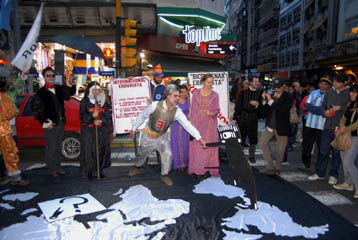
16:00- La amnesia de Clío y la revolución de sus cuerpos errantes -The amnesia of Clio and the revolution in their wandering bodies- Loreto Garin Guzmán and Federico Zukerfeld (Grupo Etcétera…) Artists, Argentine.
17:00- Round table: Jaime Iregui, Helena Chávez, Grupo Etcétera, María Iñigo Clavo. Moderator: Olga Fernández. (Universidad Autónoma de Madrid/ Royal College of Art).
PANEL II. Counterbiennials
18:15 - The Ghetto Biennale: where first world art rubbed up against third world art. Did it bleed? -Guetto Biennale: El salón de los marginados del siglo XXI. ¿Qué pasa cuando el arte del primer mundo se restriega contra el del tercer mundo? ¿Sangra?- Leah Gordon. Artist, photographer and independent video creative, London.
Reply: Change of format? Biennials, Ghetto and Pirate Bay -¿Cambio de formato? Bienales, guetos y bahías de piratas-. Olga Fernández (Universidad Autónoma de Madrid/ Royal College of Art).
DAY 2. SATURDAY. APRIL 21.
PANEL III: Spain-Latin America colonial memory
10:30 The museologic triangle of Bermuda: Prado, Museo of America and the Museo Nacional de Antropologia -El triángulo museológico de las Bermudas: El Prado, el Museo de América y el Museo Nacional de Antropología- Esther Gabara (Duke University).
11:30- The Baroque d-efect: the failure of politics and the myth of culture -El d_efecto barroco: el fracaso de lo político y el mito de la cultura- Jorge Luis Marzo (Escuela Elisava/universitat Pompoeu Fabra de Barcelona).
12:30 The Reform of Memory -La reforma de la Memoria- Eduardo Subirats . (New York University).
13:30- Round table: Eduardo Subirats, Esther Gabara and Jorge Luis Marzo. Moderator: Antonio Urquizar (National University of Distance Education-UNED-), Spain.
14:00-15:30 LUNCH TIME
PANEL IV. Spain and UK researching and exhibiting “art in/from Latin America”
15:30- Archive Policies, networked knowledge production and cultural counterhegemony: dilemmas about the revival of the experiences of Latin American conceptualism -Políticas de archivo, producción de conocimiento en red y contrahegemonía cultural: dilemas en torno a la reactivación de las experiencias del conceptualismo latinoamericano-. Jaime Vindel. (Conceptualismos del Sur), Spain.
16:30- Meeting Margins.
18:00 Round table: Michael Asbury, Valerie Fraser, Jaime Vindel, Isobel Whitteleg. Moderator: Valerie Fraser
ABSTRACTS
CorpoBraz. Giuseppe Cocco
Claude Lévi-Strauss, already in 1985, characterized the new paradigm of production and technology as a shift in the industry trend by reducing man to machine, up to the point where men will be replaced by machines. Consequently, the production of subjectivities became the terrain itself of accumulation, not in the sense of replacing men by robots, but in that of a machine-man hybrid. With this lecture, we intend to develop new reflections by taking up the aesthetics of the paltries by Glauber Rocha and especially his unfinished institution of a Brazilian "Utopya" which "metaphorizes in a Baroque symbolic language of our tropicalism, speaking as it structures the collective poyetika unconsciousness, maxim by Aleijadinjo and Vila-Lobos, image and sound by Kuerpo Brazyl, KORPOBRAZ".
Bicentennial Pavillion. Jaime Iregui
It will be addressed a series of drifts and journeys made as bicentennial counter-celebration in Bogota. Monument transformation and displacement will be reviewed in various places in Bogota in relation to the celebration of independence. Specific cases will be presented about spontaneous ceremonies and rituals in public spaces.
From Spectres and other Ghosts: Past, Memory and History. Helena Chavez Mac Gregor.
This lecture aims at placing within the Mexican the relationship between past and History. Within this frame, we will put into question the artistic and curatorial exhibitions that from 2010 (official year of the celebrations of the bicentenary of the Independence and centenary of the Mexican Revolution) till now have been trying to present a critique of History in a complex net of memories and ghosts. We want to ask these practices what kind of relationship we are establishing, within the failure of the ideological narrative structure, with History? And most importantly, what kind of subjects arises from this landscape of fragments, ruins and spectres? Will it be possible from here to generate another political formulation of History?
Racializing history and other fears... María Iñigo Clavo
Avoiding indigenous peoples' progress, the debates around the race or around the Haitian Revolution mean to evade the bond of the American Independence movements together with the vindications of the race at a moment when the notion of pure-blooded still had a huge influence on the distribution of power within the South Continent (Fernandez Retamar). This paper provides an overview of art pieces and investigations that during the last years have contributed to that racialization of the Western history, intending to expand the old framing of the narration of Modern history, incompletely told and today, from post-colonialism trends, it is aimed to redeem, under a permissive acknowledgement of what is being called “other modernities”.
The amnesia of Clio and the revolution in their wandering bodies. Loreto Garin Guzmán and Federico Zukerfeld (Grupo Etcétera...)
This lecture will address the inseparable link between art, politics and society. Assuming that any cultural manifestation necessarily reflects, testifies or leaves traces of the causes of its origin in its specific context. The poetic use of the word mirror, in this case, questions the very notion of representation and at the same time defines the cultural production as a reflex or illusion. During the lecture, the artists will present a journey through those reflections and refractions that arose as a result of the investigation within the framework of the project ESPEJOS. A project contextual en el tiempo, based on the collective investigation of extra-disciplinary collaboration, originally conceived as part of militant research on the role of the cultural industries concerning the official celebration of the Bicentenary of the Latinamerican "independences".
http://crisisrepresentacion.wordpress.com/
The Ghetto Biennale: A Salon des Refusés for the 21st century. What happens when first world art rubs up against third world art? Does it bleed? Leah Gordon.
Leah Gordon, one of the founders and curators of the Ghetto Biennale, will discuss the conception of the Ghetto Biennale and its roots in social, racial, class and geographical immobility. Gordon will discuss the multiple, and sometime contradictory, agendas underpinning the event. There will be an evaluation and comparison of the outcomes of the 1st and the 2nd Ghetto Biennales, the effect of the earthquake and the ensuing NGO culture in Haiti. There will be a presentation of a number of projects from both Biennales accompanied by images and films. Finally Gordon will discuss the potential futures of the Ghetto Biennale including collaborations with Deptford X and mechanisms to broaden the demographic of visiting participants to include a greater class and racial spread. The conclusion will be an analysis of the question ‘did it bleed’, and if so, where?
The museologic triangle of Bermuda: El Parado, Museo de America and the Museo Nacional de Antropologia. Esther Gabara
Contemporary Latinamerican art is not in vogue in Spain, although it has high selling market in Fairs and Galleries. How is this contradiction understood? Is it being created another real collection/corporative to be divided in the triangle future of Bermuda? Will those contemporary Latinamerican art pieces be destroyed or sold abroad, as were the great part of the golden pieces during the colonial time, casted in order to brace the new market economy of Spain? Intending not to limit the project to the artistic work, the current Spanish immigration politics will have its space, the renew government´s outspread of the Spanish language, and the expansion of the Spanish banks throughout Latinamerica together with cultural, educative and artistic programming.
The reform of Memory. Eduardo Subirats
Under the wide open prospect of a “Reform of Memory”, Eduardo Subirats will present a series of intellectual topics closely related with these historical dilemmas, such as the absence of a critique of the national-catholic project of 1936, and of the colonial and postcolonial cultural processes of Latin America, the absence of a enlightened intellectual reform during de eighteen, and nineteenth centuries, and last but not least the Inquisitorial destruction of sixteenth century Spanish Jewish Humanism.
The Baroque d-effect: the failure of politics and the myth of culture. Jorge Luis Marzo
From 2004 to 2011, a group of people from Peru, Mexico, Chile, Ecuador and Spain analyzed to what extent the recurrent referrals to the Baroque within the cultural tales about what is national and Latin (or Hispanic) hides certain strategies to legitimize specific models of cultural politics and of memory. This lecture will state the main arguments of the investigation process, the questions that guided him and the conclusions reached, which can be summarized as follows: when referring to the Hispanic, we are then talking about how a speech model has pervaded cultural dynamics, regardless if these dynamics account for the model. The inability to handle the Hispanic world drew the attention of the Baroque as an apparent adhesive. The self-interested impotence in the exercise of power gave rise to a sick exaltation of cultural exceptionality, which was cleverly exploited in the early eighties to spread the idea that some cultures ballasted by their anti-modernity had the best conditions to preside post-modernity.
Archives Policies, networked knowledge production and cultural counter-hegemony: dilemmas about the revival of the experiences of Latin American conceptualism. Jaime Vindel
"As a member of Red Conceptualismos del Sur, Jaime VindeI will present the general outlines of the epistemological project and the political positioning of this collective initiative and, then I will highlight the achievements as well as the contradictions that, from my point of view, the project has faced and faces. This diagnosis will enable to widely reflect on the problems of archives policies regarding the dematerialized practices, of the relation between networked knowledge production and of the inherent aporia in an attempt to "reactivate" today, the memory from Latinamerican "critical" experiences from the sixties and the seventies.
MEETING MARGINS: Michael Asbury and Isabel Whitelegg
BIOGRAPHIES
Giuseppe Mario Cocco is currently professor at the Universidad Federal of Rio de Janeiro, a member of the Graduate School of Communication and Program in Information Science (Facc-Ibict), Main Investigator of the CNPq, Scientist of Nosso Estado (Paperj) and also editor of the journals: Global Brazil, Lugar común and Multitudes (Paris). He is also coordinator of the collections (ed. DP&A) and << A Política no Império>> (Civilização Brasileira).
Jaime Iregui is an artist living in Bogotá, Colombia. His artistic work deals with a wide conception of the space and the spatial as found in practices related to information dissemination and mediating processes in the public arena.
Helena Chavez has a PhD in Philosophy from the UNAM, Mexico, and a MA at the Universidad Autónoma de Barcelona on Contemporary Art Theory. Currently, she is the Academic Curator of the MUAC, University Museum of Contemporary Art in Mexico City where she has developed the project Extended Campus a Critical Theory research program.
María Iñigo Clavo is artist and researcher. She has been Research Officer for the AHRC Project Meeting Margins: Transnational Art in Europe & Latin America 1950-1978, University of Essex. She finished her PhD at Universidad Complutense of Madridand teaches MA courses at the European University of Madrid.
Loreto Garín Guzmán & Federico Zukerfeld. In 1997 they both, with other artists, form the group Etcétera… working closely with the human rights group H.I.J.O.S. (Children for Identity and Justice Against Forgetting and Silence) in developing and popularizing “escraches,” acts of public denunciation. In 2005, together with artists and intellectuals from different places of the world formed part of the foundation of the movement International Errorist, an international organization that claims error as a philosophy of life.
Leah Gordon (born 1959 Ellesmere Port) is a photographer, film-maker and curator who has, in recent years, produced a considerable body of work on the representational boundaries between art, religion, anthropology, colonialism and folk history. In 2010 she published the photography book Kanaval: Vodou, Politics and Revolution on the Streets of Haiti.
Olga Fernández is an academic researcher, teacher and curator. Since 2009 she lectures at the History and Theory of Art Department, Universidad Autónoma de Madrid, and she is deputy coordinator of the History of Contemporary Art and Visual Culture MA. Currently, she is carrying out a research about the specificities of the exhibition medium and its critical possibilities for curatorial practice.
Esther Gabara is Associate Professor of Romance Studies and Art, Art History & Visual Studies at Duke University. Her main area of specialization is the relationship between literature and visual culture in modern and contemporary Latin America. She is currently working on a new book project on theories of fiction in contemporary artistic and popular visual culture, entitled "Non-Literary Fiction: Invention and Interventions in Contemporary American Visual Culture".
Eduardo Subirats born in Barcelona in 1947, studied in the Paris and the Berlin from the sixties. He is author of about 40 solo and collective publications among the following: Culturas virtuales (México: Coyoacán, 2001); El continente vacío (Mexico: Siglo XXI, 1994; Bogotá, 2011), Linterna Mágica (Madrid: Siruela, 1997), Memoria y exilio (Madrid: Losada, 2003), Viaje al fin del Paraíso. Un ensayo sobre América latina (Madrid: Losada, 2005). His latest books are: Existencia sitiada (México: Fineo, 2006), Arte en una edad de destrucción (Madrid: Ciencia Nueva 2010) and Filosofía y tiempo final (Madrid: Fineo 2010) Subirats is professor at New York University.
Jorge Luis Marzo (Barcelona, 1964). Art historian, art curator, writer and professor at Escola Elisava and Escola Massana in Barcelona. His latest curatorial projects are The Baroque D_effect. Politics of the Hispanic Image (2010-2011), Low-Cost. Free or accomplice (2009), Political Ads. The Spectacle of Democracy (2008). As a writer, his latest two paper The Administered Memory. The Baroque and the Hispanic (2010), May I speak to you openly, excellency? Art and Power in Spain since 1950 (2010) www.soymenos.net
Jaime Vindel. Historian, critic and teacher of contemporary art. European PhD in Art History from the University of Leon and MhD in Philosophy and Social Sciences from the Complutense University of Madrid. He has integrated several research groups, among which Research and Development project «Art and Politics in Argentina, Brazil, Chile and Spain, 1989-2004» He has been a visitor researcher at the National University of San Martin (Buenos Aires, Argentina, MOMA (Museum of Modern Art, New York, USA) and TRAIN (Research Centre for Transnational Art, Identity and Nation, University of the Arts, London, United Kingdom).
Isobel Whitelegg is Curator of Public Programmes at Nottingham Contemporary, UK. She was previously Director of the MA Curating Programme at Chelsea College of Art & Design, University of the Arts London (UAL) and is an Associate member of TrAIN, UAL's centre for research on transnational art. She writes regularly on modern and contemporary art with a particular emphasis on art and artists in Brazil, and has also curated exhibitions. She completed her MA (1998) and PhD (2005) in Art History & Theory at the University of Essex, specializing in modern and contemporary art from Latin America.
Michael Asbury is a British/Brazilian art historian, critic and curator. He is a faculty member at Chelsea College of Art and Design, University of the Arts London, where he works in conjunction with the CCW Graduate School and the Research Centre for Transnational Art, Identity and Nation (TrAIN). He received his MA in Study of Contemporary Art at Liverpool University and his PhD entitled "Helio Oiticica: Politics and Ambivalence in 20th Century Brazilian Art" at University of the Arts London.
Valerie Fraser teaches in the School of Philosophy and Art History at the University of Essex, specialising in the art and architecture of Latin America with particular emphasis on the early colonial period and the 20th/21st centuries, and on popular and indigenous culture. She is Chair of the Essex Collection of Art from Latin America (ESCALA, www.escala.org.uk). She has won a number of awards from the Arts and Humanities Research Council including funding for a fully-illustrated online catalogue of ESCALA (2002-2005) and, in collaboration with the University of the Arts in London, a major research project into artistic relations between Latin America and Europe, Meeting Margins: Transnational Art in Latin America and Europe, 1950-1978.