Activity

Activity

“I lose days, life, sleep. But it’s not my fault if I desire death and life at once, at the same time, at the same hour. And I want everything at the same time.” Alejandra Pizarnik

Girls (whispering): Hey, sweeties, are you awake?

Sadness: Yes, fully awake... It’s impossible to sleep in this heat.

Girls: Yeah, we're all wide awake as well...

Sadness: What’s up? What’s on your mind?

Girls: Nothing special... It’s just that feeling that we could maybe be somewhere else right now, you know?

Sadness: Yeah, that happens sometimes... Do you want to come over to my place? We can do something, anything.

Girls: We were thinking that it’s ages since we went to a party. A really great, fantastic party, surprisingly tender, dramatic and luminous... A party that represents us!

Sadness: Well, of course, when you put it like that! These are strange times for parties... But anyway, come over, we’ll think of something. Come now. You can even come in your pjs!

Girls: Ok, we're on our way. In any case... it shouldn’t be too hard to have party in these times, should it? In these times, a party can simply be about pausing and being together. In these times, a party can be about loving and remembering we're lovable.

Sadness: Totally. In these times, a party can be about spending a great hour dancing. A great hour singing. A great hour told well.

Girls: Invoking the night so we can see the stars, if only for a moment. Invoking the night and making it last until we drop. Tired, sweaty, listening to a story, an idea, a song.

Sadness: As Juan de Mairena said, an hour well told would never finish being told. A party can also be about celebrating time and celebrating the night.

Girls: Girls getting together for a twilight picnic. That could be nice.

Sadness: Great, so that’s what we’ll do, ok? All we need is a nice place in the open air, some music and a hundred or maybe two hundred friendly people. That will change the night completely, take it to places we can’t imagine...open it up, right?

Girls: Yes, that’s it. Let the night open up.

Open up the night.

La tristura and Mucha Muchacha arrive at the Museo CA2M this year with a joint proposal for the 2026 Picnic Sessions. What they propose is a time of listening, dancing, watching. According to anthropologists, before we shared a language we shared rituals, which is essentially what makes us human. We want to share this ancient ritual with the people of the city, share the feeling of being hospitable in this century. We’ve sought out different artists to spend a few hours with at twilight, artists who strive to establish a unique relationship with our times, who can hold their gaze in these dark times we are living through, and who can also perceive a light in that darkness. Who can see the crack. So between 28 May and 2 July we’ll meet on the museum terrace and open up the night together.

“When the light leaves
and the sky’s black,
no nothing
to look at,
day’s done.
That’s it.” 
 Robert Creeley

PROGRAMME

  • Thursday 28 May. Guillem Jiménez | Okkre
  • Thursday 4 June. Los Voluble
  • Thursday 11 June. Laura Morales | Fantasma Sur
  • Thursday 18 June. TEMPO DE FURIA (Egozkue and Paz) | Eddi Circa
  • Thursday 25 June. Carmen Muñoz | Derek van den Bulcke
  • Thursday 2 July. Natalia Fernandes | Las Víctimas Civiles

Time: 9 pm to 11 pm

CURATED BY:

Celso Giménez and Violeta Gil, members of La tristura, have been working in the performing arts field since they were twenty years old. Trying to generate “human situations” on and off the stage. Investigating the limits between presentation and representation, with a special focus on contemporary theatre, and committed to the intuition that intimacy and poetry are essentially political concepts. During this time, La tristura has collaborated with venues like the Teatros del Canal in Madrid, the Grec Festival in Barcelona, Cena Contemporânea in Brasilia, the Théâtre de la Ville in Paris, Noorderzon in Groningen, and the AUA Festival in Bern, among others. Over the years they have also generated contexts like the Escuela de Invierno, Festival Salvaje and the Gran Convocatoria Mundial, all with the desire to keep connecting different agents and artists, trusting that these connections will give rise to unexpecting and inspiring movements. In recent years they have started solo projects and new collaborations in the fields of cinema, the stage and literature. Their work is still tied to Madrid, the city where they live and develop their projects.

Ana Botía and Belén Martí have been directing the dance company Mucha Muchacha since 2016, together with Marina de Remedios and Marta Mármol. Since the outset, their work has been focused on researching the body as a space of memory, identity and transformation, creating proposals that combine tradition and contemporaneity. Their performance language incorporates elements of folklore, pop music and Spanish dance codes, reconfigured through a critical gaze rooted in the present.  Since its birth the company has created Volumen 1 (2019), Mucha Muchacha (2021), Para cuatro jinetes (2023) and more recent projects like Cantar de gesta (2026) in which they continue to explore the relationship between body, narrative and collectivity. Mucha Muchacha has developed a collaborative practice with artists from different disciplines, generating research and mediation projects like SERÉ FOLCLORE and the TALLER-FIESTA project.

Activity type
Dates
28 May – 2 July
Target audience
Topics
Entrance

La Tristura and Mucha Muchacha are coming to the CA2M Museum this year to present the Picnic Sessions 2026. They have invited a range of artists to join them for a few hours at dusk. And so, between 28 May and 2 July, we’ll gather on the museum terrace to welcome the evening together.

Categoría cabecera
Picnic 2026
2026 PICNIC SESSIONS: OPEN UP THE NIGHT
More information and contact
Media footer

Illustration: Adara Sánchez.

Is it a cycle?
Disabled
With the support of
Duration
21:00 - 23:00

In this workshop we’ll approach the Tarot as a creative, symbolic and deeply personal tool. We’ll begin by exploring archetypes, memory and autobiography, and then we’ll use drawing to make a unique card that represents you: your card.

Each participant will create their own Tarot card, developing its symbols, meanings and narratives. It’s not a question of learning a closed system, but of opening up a space where the intuitive and the personal guide the process.

During the workshop we’ll look at examples of influential Tarots like Dorothy Iannone’s (Ta)Rot Pack, using Aitor Saraiba's Tarot of Light as our compass to understand the Tarot as a living language that can be reinterpreted through individual experience.

Drawing skills are not required. The approach is free, accessible and focused on the process rather than the result.

This workshop is also a first step for anyone who wants to embark on the journey of creating their own complete Tarot deck, beginning with a card that will operate as the starting point and seed of a personal symbolic universe.

Aitor Saraiba is a multidisciplinary artist whose practice revolves around drawing as the primary tool of exploration. Using this medium, he expands his language to encompass different formats, from ceramics to textile art, building a personal universe defined by a constant dialogue between the manual and the symbolic

His work is inspired by a quest to connect with the invisible, to shape what doesn’t always have a name. In this process, drawing becomes an intimate, spiritual channel. As a result of his research, in 2021 he created the Tarot de Luz, a work that has sold more than 30,000 copies worldwide and has been translated into several languages, making it one of his most influential pieces.

Saraiba’s work is deliberately situated at the margins of the artistic establishment. His interest lies in the artisanal, ancestral and intuitive, with parallels in outsider art, pop art and mystical tools. From that place, he has forged an honest, personal language that champions emotion, imperfection and spiritual connection as forms of knowledge.


Activity type
Dates
12 May
Target audience
Registration
-
Topics
Acceso notas adicionales

CAPACITY: 20 PEOPLE.

Entrance

In this workshop we’ll approach the Tarot as a creative, symbolic and deeply personal tool. We’ll begin by exploring archetypes, memory and autobiography, and then we’ll use drawing to make a unique card that represents you: your card.

Actividades asociadas
Subtitle
WORKSHOP FOR ADULTS
Categoría cabecera
Tarot
IMAGES THAT SPEAK OF YOU: CREATING YOUR OWN TAROT CARD WITH AITOR SARAIBA
More information and contact
Media footer

Aitor Saraiba’s Tarot of Light

Is it a cycle?
Disabled
Duration
From 18:00 to 21:00

Directed by: Carmen Aldama

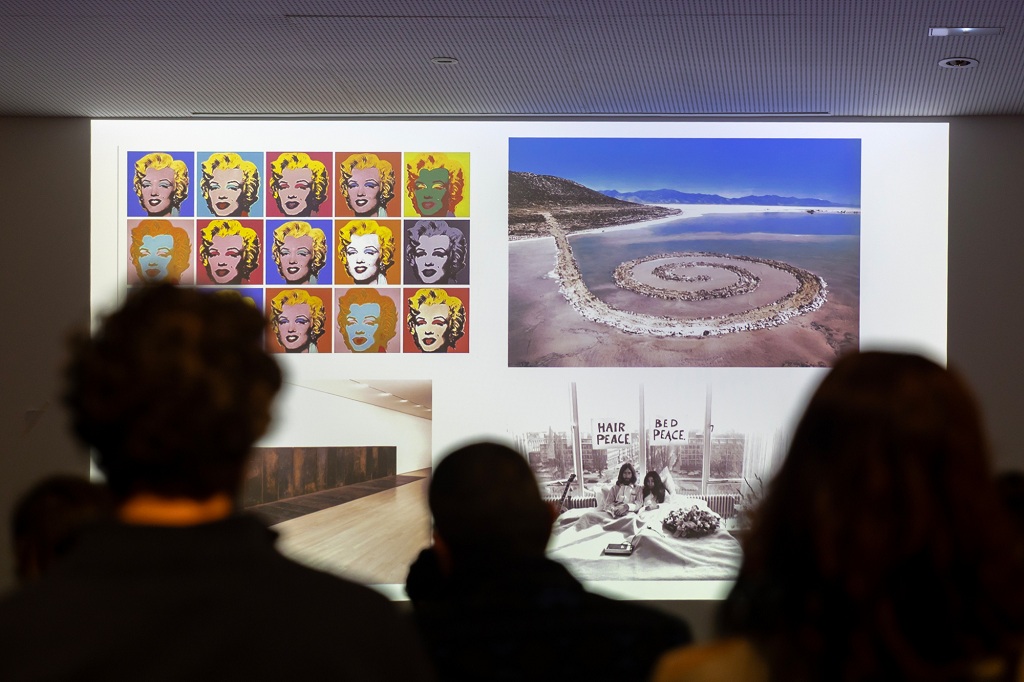
“A new terrain where everyone is welcome, where education dresses up in its finery and science is fun. Every night the Universidad Popular will become a type of free and free-of-charge theatre of education,” wrote Blasco Ibáñez in the newspaper El Pueblo in January 1903. Blasco Ibañez founded the first people’s university in Valencia, which drew far greater numbers of attendees than the students enrolled in the official university. Now, in the present, we fantasise with the idea that the attendees of the “theatre of education” challenged the authority of the well-meaning teachers, who were devoured by popular wisdom. The photograph would have been taken moments before the storming of the rostrum. 

Following model of adult education centres, since 2008 the Museo CA2M has been running the People’s University programme as a space to reflect on the nature of art today. Over the years, the lectures given by art history and philosophy academics have gradually incorporated other forms of learning based on artistic practice, and artists have been invited to share their working methods and processes. The People’s University attendees have always participated vigorously in the discussions and played an active role in the sessions with the artists, to the extent that they have ultimately become the protagonists of the lecture series. For that reason, the research topic for the 2026 edition of the People’s University is the actual learning group that emerges and flourishes around the programme. A group that is always varied, genuine and fluctuating. 

Over the course of five sessions, we’ll experiment with insubordination, anonymity, collective authorship, resistance, radical confidence, power, cannibalism and other heroic fantasies with which to unleash popular energy. 

PROGRAMME

  • Wednesday 22 April. THE ARTIST IS PRESENT. Javier Tirado Ocón 
  • Wednesday 29 April. SEASON FINALE. Cuqui Jerez
  • Wednesday 6 May. DEVOUR ME AGAIN. Aitana Cordero
  • Wednesday 13 May. TEACHING THOSE WHO DON'T KNOW. Carmen Aldama
  • Wednesday 20 May. GRAND FINALE. Ben Attia and María Moncada
Activity type
Dates
FROM 22 APRIL TO 20 MAY
Target audience
Registration
-
Acceso notas adicionales

Limited capacity

Entrance

Over the course of five sessions, we’ll experiment with insubordination, anonymity, collective authorship, resistance, radical confidence, power, cannibalism and other heroic fantasies with which to unleash popular energy. 

Subtitle
PEOPLE’S UNIVERSITY
Categoría cabecera
UP 2026
“THEN THE ATTENDEES CLIMBED ONTO THE ROSTRUM AND DEVOURED THE SPEAKERS”
More information and contact
Media footer

Blasco Ibáñez on Calle de San Vicente upon his arrival in Valencia. Ajuntament de València. Imagen: Arxiu Històric.

Is it a cycle?
Disabled
Duration
Afternoon session (to be confirmed)

In April and May the curators of the Ester Partegàs and Dorothy Iannone exhibitions, Bea Espejo and Tania Pardo, will take you on a tour of the shows, pointing out the hallmarks of the artistic practices of these two creators.

MINOR ARCHITECTURE BY ESTER PARTEGÀS, curated by BEA ESPEJO

The world in our pocket

Having the world in our pocket is like inhabiting a minor architecture. It alludes to something small that leads to many things, highlights the value of what is within our reach, and celebrates the sensation of confidence we feel when we achieve a lot with very little. It also operates as metaphor for the condensation of the world: something immense, complex and infinite that can be concentrated in the palm of our hand. This thrill of understanding the world and seeing the inexhaustible in the everyday provide the premise for reflecting on Ester Partegàs’s work. 

  • Tuesday 14 April, 6.30 pm
  • Saturday 23 May, 12 pm

OVER AND OVER AGAIN BY DOROTHY IANNONE, curated by TANIA PARDO

Let’s talk about Dorothy...

The sixties, the Tarot, Dieter Roth, Sarah Pucci, Fluxus friends, Berlin, Düsseldorf and hundreds of recipes. Autobiography, love and the domestic realm were tools of exploration in Dorothy Iannone’s art. The intimacy and power of her works can also be interpreted as a space of women’s liberation, where the personal becomes political. In this tour, books, paintings, sculptures and sound boxes, saturated with text and colour, provide a gateway into Iannone’s universe and the central themes of her work: eroticism, sexuality and friendship.

  • Saturday 18 April, 12 pm
  • Saturday 23 May, 1 pm
  • Saturday 13 June, 12 noon

Activity free of charge. Please register in advance by calling 91 276 02 21 or writing to ca2m@madrid.org 

Activity type
Dates
APRIL–MAY–JUNE
Target audience
Topics
Acceso notas adicionales

CAPACITY: 20 PEOPLE

Entrance

In April and May the curators of the Ester Partegàs and Dorothy Iannone exhibitions, Bea Espejo and Tania Pardo, will take you on a tour of the shows, pointing out the hallmarks of the artistic practices of these two creators.

Categoría cabecera
visitas comisarias
GUIDED TOURS OF THE EXHIBITIONS
More information and contact
Media footer

Picture: Sue Ponce.

Is it a cycle?
Disabled
Duration
1 HOUR

Have you ever stopped to think about how the bonds between people are manifested? Friendship, family and romantic relationships, needs and plans, desire... The emotional fabric is packed with feelings and concepts that become invisible lines leading and connecting us, constantly tightening and slackening, sometimes without us even noticing.

On this occasion we propose to enrich the research project Un juego de cuerdas y sus 12 leyes [A String Game and Its 12 Laws] with a collective game dynamic in which we’ll explore these and other bonds in a palpable, sensory way through knots and links.

We invite you to get tangled up with us and let go of the rope with the artist and researcher Inés Sorlat, who will use her practice to move the strings. Thus begins Intermittences, with the focus on what is there but might not always be there, on what is tightened but might also slacken.

Inés Sorlat (Madrid, 1993) is a multidisciplinary artist and Audiovisual Communication graduate of the Carlos III University in Madrid. Her work combines audiovisual narrative, installation and sewing, investigating the bonds between people and the invisible laws that uphold them. This exploration led to Un Juego de Cuerdas y sus 12 leyes, a series of twelve conceptual installations that reflect on relationships as a single interconnected system.

In 2025 she presented the first two pieces, Ley 8 and Ley 11, and she is currently developing the following works in the series, visually representing the system and its strings, and, one by one, reinterpreting their laws.

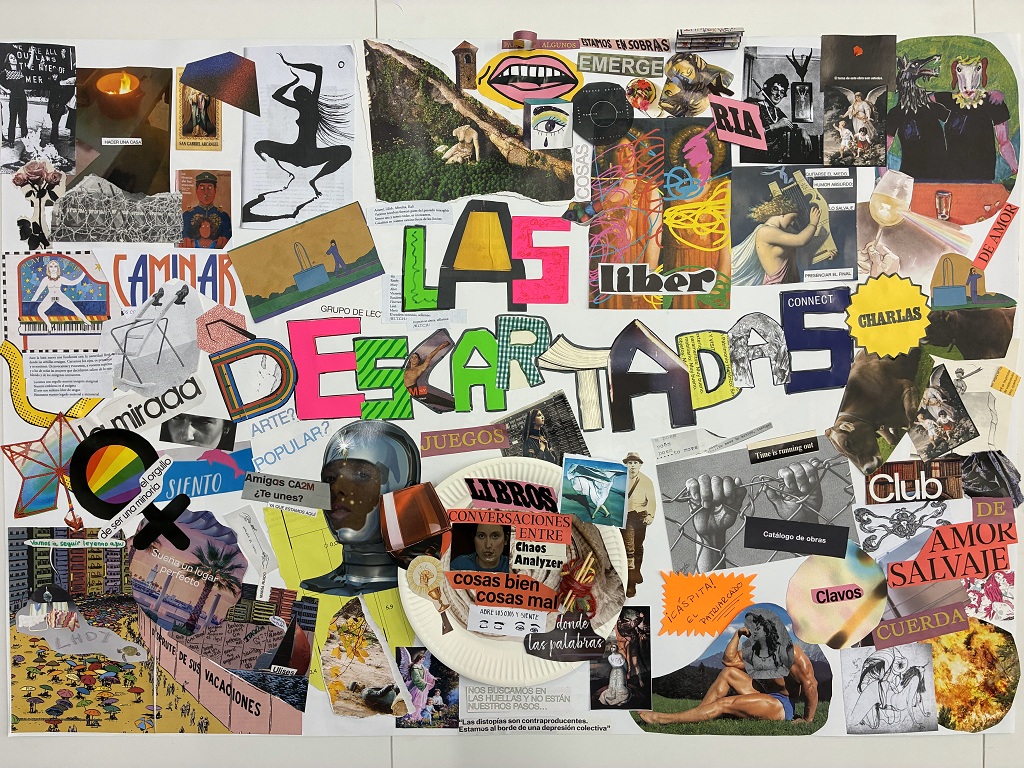
Donde Continúan las Cosas is a group formed by past participants of our programmes for young people, united by their interest in culture, art and community work. The project aims to redefine relationships with the museum, fostering the self-management of the group members and involving them in the definition of programmes for young people.

Activity type
Dates
UNTIL JUNE
Target audience
Acceso notas adicionales

CAPACITY: 15 PEOPLE.

Entrance

Donde Continúan las Cosas is a group formed by past participants of our programmes for young people, united by their interest in culture, art and community work.

Subtitle
OPEN WORKSHOP FOR YOUNG PEOPLE AGED 16 AND OVER
Categoría cabecera
dc las cosas
DONDE CONTINÚAN LAS COSAS: INTERMITTENCES
More information and contact
Media footer

Picture: Donde continúan las cosas

Is it a cycle?
Disabled
Duration
17:00 - 20:00

FUGA is a space where we continue to promote autonomy, exploration and collective undertaking. We don't impose anything here and there are no closed hierarchies: the group members design the programme together.

After a first year of sharing, experimenting and learning—a year of discovering how difficult but how rewarding it is to create a genuinely collective space—the group embarks on this new phase with a clear aim: to create their own podcast.

The podcast will be a tool for engaging with the museum’s programmes and exhibitions, but also for looking beyond them. It will enable us to map the contemporary art scene, interview artists and curators, visit spaces, chat with cultural agents and make our own voice heard in what is happening right now.

We want FUGA to be a place where we can continue adding to a collective archive, where we can explore current initiatives together, formulate theories, ask questions and continue to engage with the museum from the perspective of our own interests and languages.

We’ll meet twice a week during the year in a friendly, horizontal and experimental setting to design the podcast, record episodes, explore topics, invite people and create a project that is truly ours.

Activity type
Dates
SATURDAYS
Target audience
Entrance

After a first year of sharing, experimenting and learning—a year of discovering how difficult but how rewarding it is to create a genuinely collective space—the group embarks on this new phase with a clear aim: to create their own podcast.

Subtitle
GROUP OF YOUNG PEOPLE AGED 16 TO 23
Events
Categoría cabecera
Fuga 2026
FUGA 2026
More information and contact
Media footer

Photo: Sue Ponce.

Is it a cycle?
Disabled
Duration
ONCE A MONTH

Inspired by Dorothy Iannone’s A Cookbook, made in 1969, the writer María Arranz proposes a workshop aimed at the creation of a collective recipe book. Based on a survey of the literary and artistic works of different creators who have made cooking a focal point of their lives, Arranz invites us to take part in a space designed to identify connections between the world of food and other fields like creation and writing that combine art, food and life.

In A Cookbook, Dorothy Iannone shows us that a collection of recipes can reflect not only daily life but the author’s existential musings. While a recipe book can be intimate and introspective, it also speaks to us of domestic and popular culture, of the time and place in which it was compiled. On loose sheets of paper, in notebooks or in published works; with or without drawings; with notes in the margins; with stains and splashes or pristine; inserted with tips honed from years of trial and error, or with precise instructions that leave no room for improvisation. A recipe book reveals many things and therefore demands attentive reading, much more attentive than has historically been granted to these texts. In this workshop we’ll talk, reflect on, discuss and, above all, read recipes, relating these readings to Dorothy’s work and those of other artists and authors who have also found a unique form of expression and thought in cooking.

María Arranz is a writer and a journalist specialising in cultural, feminist and gastronomic topics. A regular contributor on gastronomy to media like El País, she is the author of El delantal y la maza (Col&Col ediciones), an essay about the role of women in the kitchen from a feminist perspective. Among many other interests, in 2013 she founded FUET Magazine, which examines the relationships between food and culture, and she was a member of Cocinar Madrid, a multidisciplinary collective that uses cooking as a tool of anthropological research.

Activity type
Dates
MARCH
Target audience
Topics
Entrance

Inspired by Dorothy Iannone’s A Cookbook, made in 1969, the writer María Arranz proposes a workshop aimed at the creation of a collective recipe book.

Subtitle
CREATIVE WORKSHOP
Categoría cabecera
taller cocina
WRITING, COOKING AND AUTOBIOGRAPHY
More information and contact
Media footer

A Cookbook, 2017. Courtesy: The Estate Of Dorothy Iannone & Air de Paris, Romainville | Grand Paris © Marc Domage

Is it a cycle?
Disabled
Duration
18:00 - 20:00

The shelter, retreating to the shelter 
the cave, the cave
the sound box between the shelter walls
the acoustics of the drawings
there where it sounds
we’ve been here for eight years and never sung a full song 

Beyond the end we have never sung
of those lost to the river
from the river to sea
cocorococo

Beyond the urgency-attention
uncertain-subtle-unfinished-unspeakable-invisible
attention intention
being in the phase, in the 3rd phase, not of autonomy but of self-management 
corococo coco cocorococuuuuuuuu

Beyond a new gentleness
that must be invented 
becoming a body of affectations
a beast of a thousand heads with a thousand tongues
reemerges in the shelter of the cave


An amateur choir is a creative project in which any kind of voice is welcome to participate. Every other Thursday, we do our own research sessions as well as sessions with artists who work with voice and listening.

Session dates of An Amateur Choir 2026

15 January / 29 January / 12 February / 26 February / 12 March / 26 March / 9 April / 23 April / 7 May / 21 May / 4 June / 18 June / 1 October / 15 October / 29 October / 5 November / 19 November / 3 December / 17 December.

Those who have come in the past:

An Amateur Choir has featured Sonia Megías, Itziar Okariz, Jaume Ferrete, María Salgado and Fran MM Cabeza de Vaca, Rocío Márquez, Alma Söderberg, Ainara Lagardon, Jhana Beat, Juan G. Araque (Juan Dresán) and Lolita Versache, Luz Prado, Los Torreznos, Makiko Kitago, Julián Mayorga, Agnès Pe, Paloma Carrasco, Anto Rodríguez, Elisa C. Martín, Elena Murcia Pinto with Marina Peralta Murcia, Inma Marín with Jon Cañal and Tania Arias Winogradow with Milo-Andrey Ulises, Rolando San Martín, Amalia Fernández, Elena Córdoba, Raquel G. Ibáñez, Alex Reynolds, Black Tulip, tacoderaya, Mónica Valenciano, Ruth Abellán and Arturo Moya, Ojo Último, Monserrat Palacios and Fátima Miranda, Sole Parody, Enrico Dau Yang Wey, Coco Moya, Veza Fernández, Patricia Leguina, Jesús Burrola, Noela Covelo, Stina Force, Los Cramps (Nilo+Francisco), Ángela Segovia, Eddi Circa + raxet1, E1000, El Gato with Jotas, Nilo Gallego, Tavi Gallart, Hijas de Yocasta, Amaia Bono and Damián Montesdeoca, Piccola, Bea Narcoleptica and Elan d’Orphium.

Activity type
Dates
FROM JANUARY TO DECEMBER
Target audience
Entrance

An amateur choir is a creative project in which any type of voice is welcome to participate. Every other Thursday, we hold our own research sessions as well as sessions with artists who work with voice and listening.

Subtitle
IN THE SHELTER OF THE CAVE, THE CAVE...
Categoría cabecera
coro 2026
AN AMATEUR CHOIR 2026
More information and contact
Is it a cycle?
Disabled
Duration
17:00 - 20:00

MATINEES: EXPANDED CINEMA FOR FAMILIES 2026

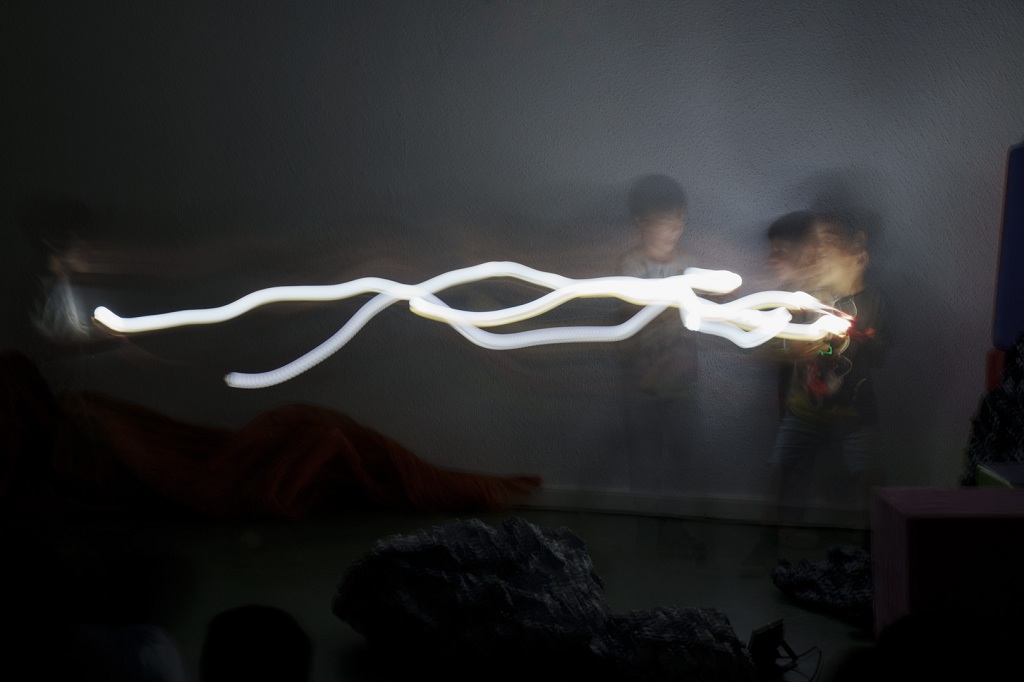
Matinees is an open, flexible space in which cinema expands: the cinematographic experience spills out of the screen and invites your active participation, regardless of your age.

The white cinema screen—that flat, opaque surface—is also a place to plunge into, to dive down to unsuspected depths. It can spill out of the sides, splashing and soaking everything around it, rising up to the ceiling and raining down from above. The images can adopt unimagined forms: unspeakable, immeasurable. We can watch them from a seat, or alternatively lying down, arm in arm, scattered across the room. Even with our eyes closed. We can touch the light, feel its colours, listen to it like a whisper, like a song. And we can do all of this together, in a room with no seats, no tickets and no popcorn. We believe there are many ways to watch cinema that have yet to be discovered. To explore them, we’ve invited various artists and filmmakers to imagine what those ways are and what other type of cinema has yet to be experienced. The Matinees take place on Saturday mornings and each session will be different: a proposal, an experiment, a challenging experience. We invite you to come with your best friends, your siblings, sons, daughters, dads, mums or grandparents and discover cinema like you have never imagined it. You’ll find all the details and session times here very soon, but for now here are the sessions dates and guests.

PROGRAMME 

28 FEBRUARY | MAIDER FERNÁNDEZ IRIARTE

7 MARCH | MARTA AZPARREN IN COLLABORATION WITH TANIA ARIAS WINOGRADOW

14 MARCH | GÉNESIS VALENZUELA AND MANUEL MUÑOZ 

21 MARCH | ANGIE DE LA LAMA

TIMES: 11.30 am** Time subject to change

Everyone is welcome at the Matinees. We want this programme to be a place for sharing, regardless of age. Babies, boys and girls, young people, adults and seniors: come and join us. You’re free to enter and exit the room during the sessions.

Activity type
Dates
SATURDAYS FEBRUARY-MARCH
Target audience
Acceso notas adicionales

AFORO: 60 PERSONAS

Entrance

Matinees is an open, flexible space in which cinema expands: the cinematographic experience spills out of the screen and invites your active participation, regardless of your age.

Categoría cabecera
matinales 2026
MATINEES: EXPANDED CINEMA FOR FAMILIES 2026
More information and contact
Media footer

Picture: Sue Ponce.

Is it a cycle?
Disabled
Duration
4 sessions

These tours of the Ester Partegàs, Dorothy Iannone and Antonio Ballester Moreno exhibitions don’t seek categorical answers but open up a space where the experiences of visitors, and of groups that now form part of the museum, are put into play and create networks. We want to reflect together on it what means to tour an exhibition using conversation, listening and the difference of gazes.

How does what we see change when we focus on the fragment, the framing or the time we dedicate to a work?
What do we really use when we look at a work?

“What the eye doesn't reveal” proposes a tour where framing, fragment and time are mobilised to provide a deeper insight into Sky and Earth by Antonio Ballester Moreno, Minor Architecture by Ester Partegàs, and Over and Over Again by Dorothy Iannone. Three proposals which, each from a very different place, invite us to think about what falls outside the spotlight, about what is repeated and transformed, and about the intimate, the body and the everyday as territories of meaning.

A space to pause at the details and accept the partial gaze, allowing the works (and other people as well) to interrogate us, disturb us or connect us from unexpected places. A tour where the fragment is not something incomplete but a possibility; where the framing is not a limit but a revelation; and where time is measured not as duration but as intensity of the experience.

The tours will be accompanied by Francisca Soto Martínez (Santiago de Chile, 1989), artist, restorer and educator based in Spain. A member of the El Hueco collective, her work is situated at the intersection between collective memory, community building and cultural mediation, exploring the frictions between art, restoration and education.

Activity for the general public every Sunday at 12.30 pm

  • Maximum capacity: 12 people
  • Advance registration: 91 276 02 21 or ca2m@madrid.org
  • You can also sign up directly at the Museum reception.

Group tours on Wednesday mornings

If you belong to a collective, association, educational establishment or informal group, contact us to arrange a tour by calling 91 276 02 27 or writing to educacion.ca2m@madrid.org

Activity type
Dates
EVERY SUNDAY AT 12:30
Target audience
Acceso notas adicionales

CAPACITY: 12 PEOPLE

Entrance

These tours of the Ester Partegàs, Dorothy Iannone and Antonio Ballester Moreno exhibitions don’t seek categorical answers but open up a space where the experiences of visitors, and of groups that now form part of the museum, are put into play and create networks. We want to reflect together on it what means to tour an exhibition using conversation, listening and the difference of gazes.

Subtitle
TOURS OF THE EXHIBITIONS
Categoría cabecera
visitas domingos
WHAT THE EYE DOESN'T REVEAL
More information and contact
Media footer

Picture: Sue Ponce.

Is it a cycle?
Disabled
Duration
12:30- 14:00